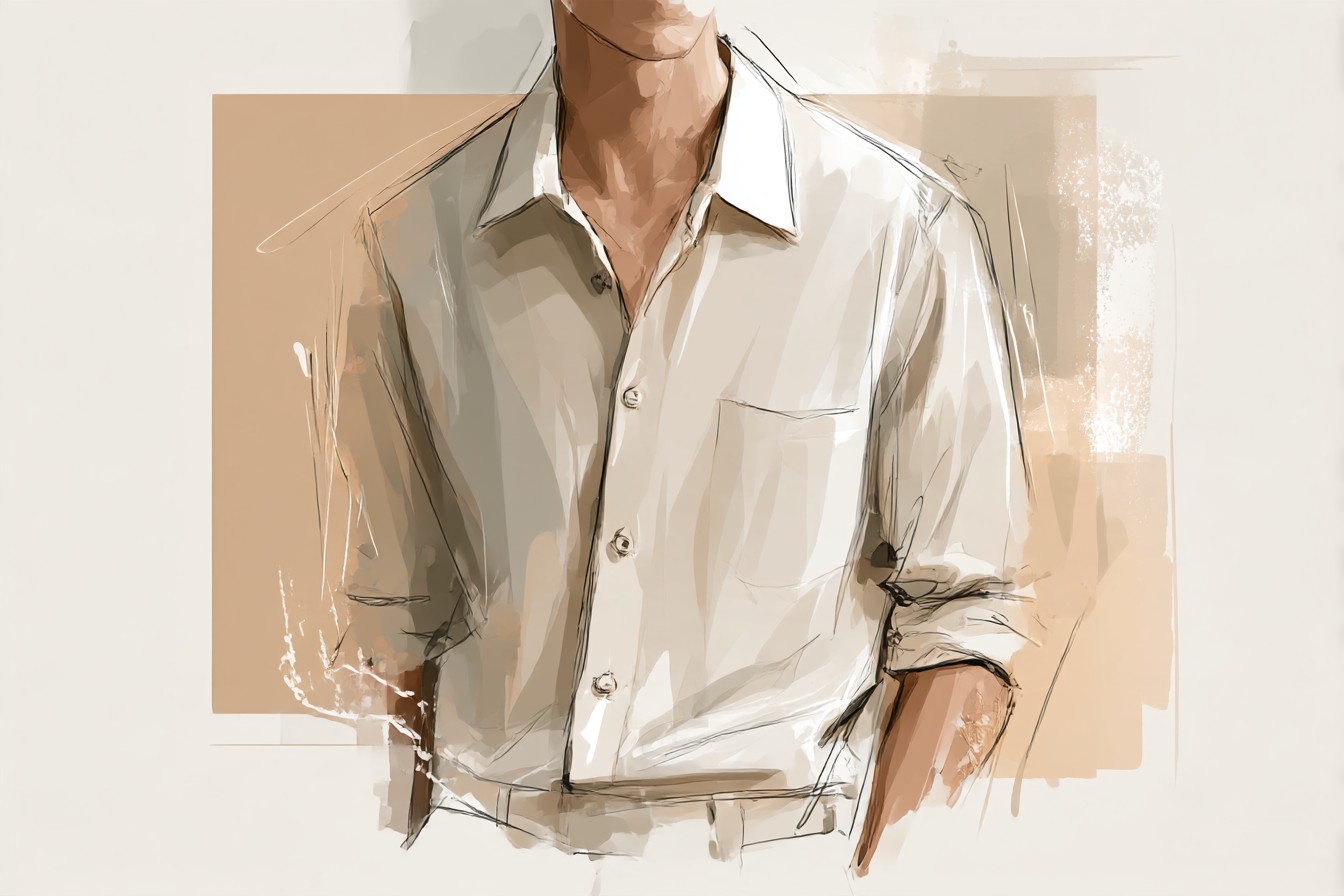
My father always ironed his collars so stiffly that they could’ve cut paper. When I was maybe ten years old, I remember asking him why that odd triangle flap sat atop everything else a shirt was already doing at its collarbone. He gave me a look like I’d asked why water is wet. “That’s just what a shirt looks like, Callum.” Fair enough, at the time, but ever since then every Sunday morning I’ve found myself rifling through some church yard sale bin wondering about it anew. Grabbing shirt after shirt and pulling out that same bizarre architectural flourish fastened to their necks like nobody ever thought to question it.
The collar, when you actually spend time thinking about it, is a genuinely strange piece of apparel engineering. It’s a piece of fabric folded over itself and frequently reinforced with another layer of fabric or interfacing sitting there around your neck doing nothing useful all day except standing there. Collars don’t keep you warm like a scarf.
They don’t particularly protect you like they once might’ve either. And yet it’s the very first thing anyone looks at when they’re inspecting whether or not a shirt is made well, the shape, the roll, how it compliments a jacket lapel. All this scrutiny over a garment feature that, when you think about what it’s doing, isn’t actually doing anything.
The collar used to actually work for a living
I’ll give you a little secret I learned scouring through old people’s empty closets for the last ten years. The tag and the collar are more telling about a garment’s true age than any price tag guess will ever be, and collars especially are a little time capsule if you know what to look for. Collars far enough back weren’t decorative at all, they were doing the heavy lifting your shirt couldn’t. Detachable collars, button on neckties separate from the shirt itself, were actual shirts people wore. Buttons aligned on your neckband with identical holes on the collar so you could wear your shirt for days without washing but change out the collar itself, the part that actually touches your neck and collects your sweat and grime throughout the day, for something fresh. Doing an entire shirt was expensive and took forever without whatever mechanic ran the washer doing it for you. Starching and whipping out a little detachable collar was cheap and fast.
I came across a whole pile of collarless shirt bodies in what at the time was the biggest score of my life at an estate sale outside Bloomfield. The kind of stack where you half don’t even open the box because it just looks like puff of white nothing and then you notice there’s no collar sewn onto any of them, just the barest neckband with tiny buttonholes dangling uselessly without a collar to attach to. That’s when the whole detachable collar era really sunk in for me. Someone wore that shirt for seven consecutive days and just clipped a clean collar on every morning like it wasn’t the same shirt.
And suddenly the collar’s reason for existing is obvious. It wasn’t there to look sharp first and foremost, it was there because that was the part of your shirt that got dirty quickest and it made economic sense to quarantine that into one place you could at least scrub by hand. Everything about how we think of collars now came later, from the shape to how stiff they are. The starch came long after someone figured it was cheaper to just wash that one part versus the whole garment.
Somewhere along the way it stopped working and started performing
Washers came along and shirts became cheap enough to launder in full so the detachable collar went away, but the collar itself didn’t so much disappear as it did evolve from serving a purpose to representing one. And here’s the thing I love about the collar’s journey, we kept the same general shape long after it stopped serving its original purpose. Collars turned from a hygiene choice into a status choice; whether you worked hard enough to be out of doors and needed a soft collar or had the standing to sit at a desk and starch yours into a personal war with wrinkles.
You can basically trace blue collar versus white collar work from that sentence right there. Neither of which fully clicked with me the first time I heard it either, honestly. It’s too perfect, too ‘Illustrated History of Collars tells readers this for things to have actually gone down that way. Except they did. Blue collar workers wore darker collars that would hide stains and grease. White collar shirts had stiff white collars because they could. Washing a white collar was harder than washing a blue or cami so having access to the money and the time to keep yours white was the point of doing it. Your collar went from keeping you from sweat to who you wanted to let people know you were without saying a word.
I’ve got one hanging in my closet as we speak actually, probably the very shirt I’ll wear tomorrow.

Picked it up off a folding table last week from the lady that runs the Sunday sale down by the Methodist church that’s been there for as long as I can remember – going on eight years now – for four dollars and the collar tells you everything you need to know about where we wound up. It’s a button down collar, soft where older detachables I’ve found would be starched stiff as cardboard. It’s almost floppy. But that’s because someone else solved a problem way back when that needed solving; polo players got tired of their collars getting in the way of their swing so they stitched the damn things down for good. Brand turned a hack fix into a style that’s lasted decades past the initial problem.
The collar these days isn’t really doing anything for most of us. It’s not protecting us from sweat or dirt (most men won’t even bother popping their collars off and washing them separately from the shirt body anymore), hell it’s not even keeping golf balls away from your neck most of the time. Instead our collars tell everyone something about who you are before you’ve had a chance to speak. Maybe the oddest part about the journey of one little flap of fabric.

Callum has spent ten years digging through car boot sales and charity shops in Glasgow. He writes about vintage menswear and old workwear, and he’s happiest when he’s found something good buried at the back of a rail.