“It just loops twice and hangs, nothing to it.” A salesman from some brand of outerwear that no longer exists told me back in about 1988, looming over me in the middle of my own department while I struggled to dress a mannequin for a window display. Nothing to it. I’ve carried that sentence around for thirty five years the way some people nurse a tooth infection. It isn’t wrong. It’s just needlessly reductive, giving someone only enough information that they could conceivably walk away convinced you’ve helped them without getting caught on the details. Like if someone asks you how to parallel park and you respond “just steer.”
A scarf on actual neck, in real world weather, does not behave the way it does on a mannequin or sitting flat on a display table.

It has mass. Sometimes too much. Sometimes too little. It intersects with a coat collar in ways that collar might not want to cooperate. When people ask me about wrapping a scarf and I get irritated, that’s what they’re asking about. But they’re asking two questions that get bundled into one, and treating them as one problem is why so many grown men accidentally dress like elementary school boys who were roughed up by fabric. One question: what is the scarf itself made of, how is it built? Two: where are you actually putting that loop when you’re done making it?
The scarf you bought is doing half the work before you touch it.
Let me have a talk with whoever picked out a scarf in 1994 because it was legitimately the softest thing in the store. Soft is not a goal, that’s merely a feature. Usually of things that can’t actually hold a wrap because they’re too thin and too light. That scarf fluttered around my neck like a damp towel from the day I purchased it until the day I finally gave it to my brother’s dog to torment because he was chewing through shirts and that tells you exactly how useful I found it as an accessory. Scarves need some weight and body to them to have the decency to hold the damn fold you put in them, otherwise every style you wrap it into is just going to slide back out and droop around your neck within four minutes, turning the simple act of turning your head into a chorus of readjustment at every traffic light.
Wool is the magic material that does this and I don’t mean that bullshit acrylic yarn they pass off as wool these days. A good thick lambswool or merino scarf, something with an actual heft to the fabric itself will maintain that loop shape because it actually has the friction and mass to stay stuck to itself. I’ve got an absurdly thick wool scarf from god knows where around 2005 that not only retains its shape better than a cashmere scarf I bought in 2018 at three times the price but the cashmere scarf is objectively the better made item of clothing. Cashmere feels amazing against your neck but sucks at holding any kind of wrap unless it’s knit insanely thick and heavy, which sort of defeats the point of spending money on good cashmere because what makes it good also prevents it from doing its job here. If the wrap is what you care about the fiber content on your scarf matters long before the price tag does and we are well beyond any point where that should be a punchable problem for a fifteen dollar difference.
Length and width are important and discussed half as much. Short scarves don’t give you any options outside of folding them flat and calling it a day because there’s literally not enough material to wrap otherwise without choking yourself. I’ve owned one about fifty four inches long that I was physically incapable of wrapping due to it just looking like a bib around my neck, and wore it flat two winters because of how convinced I was that looking like hip refuse was inherently stylish. It wasn’t style, it was a poorly made scarf. Get shorter than about sixty inches and you will have that problem every time with every scarf that’s not up past your waist. Get longer than seventy five inches and suddenly you’ve got options, including ones that don’t scream “novice.”
The wrap itself is an intentional decision.
This is where I’ll probably part with more articles than I agree with on this. The European loop, scarf folded in half, pull ends through loop, is treated like its the whitewater version of scarf wearing online and it’s fine, don’t get me wrong. It’s quick, it looks neat, and it keeps both ends out of your face so you don’t have stuff flying everywhere on the subway platform because someone decided to sneeze on the trains again. But it also hugs your neck in basically the same way no matter what you’re wearing.
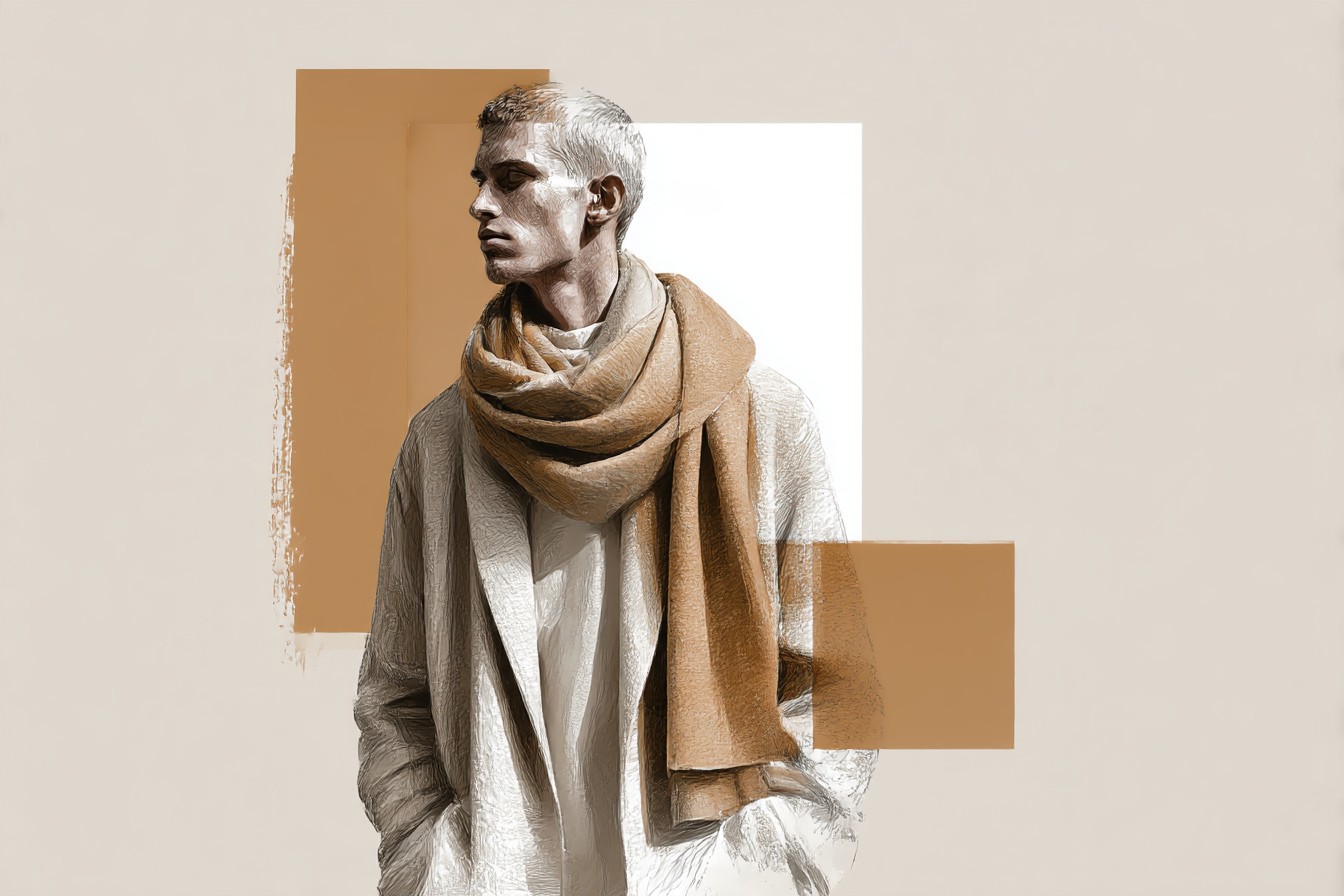
Everything gets pushed up into this neat knot right below your chin and after you’ve done that for enough winters it just starts to feel like a uniform you’ll never get out of rather than you picking that as your look.
The simple wrap around, going around once with both ends hanging down in front of you does one thing that loop absolutely cannot, which is allow the scarf to actually integrate as part of your coat instead of something added on top of it. Requires a longer scarf to not look like you half-assed a loop or that you just ran out of scarf halfway through, but when it fits right it also looks like you didn’t try, which is about half the appeal of what you wear in winter. Got my brother last year staring at me while I wore one for maybe thirty seconds before his next sentence to say “that’s looks better than normal.” My brother who has offered me, what, six fashion opinions in my entire life that I didn’t explicitly ask for. Priceless.
TLDR version on scarf wears: there’s no single right answer and anyone who tells you differently wants you to buy from them. Different materials feel different, different knots suit different personalities and thicker scarves simply go with more options. Find what works for you. Wrap it how you want.
But it does matter how you wrap it, just as much as the scarf you choose matters. Find a happy medium of the two that works for you and you’ll spend less time looking down at your neck and more time looking forward to where you’re going.

Reg spent thirty years buying for a menswear shop floor in Sheffield before it closed. He writes about clothes built to last, compares every new buy with something he’s owned for twenty years, and has made most of the expensive mistakes already.