A friend of mine, Danny, recently texted me a photo of himself half-in, half-out of a running store dressing room wearing one Brooks Ghost on his left foot and its women’s equivalent on his right foot. Both shoes were stamped with the same size box on the underside of the toe box. The message accompanying said photo read simply, “these are not the same shoe, Marcus, I don’t care what the internet says.” His facts were accurate but honestly just completely besides the point, which is basically where we’re gonna start this whole conversation.
I’ve run in both shoes. I, at this moment, own a pair of women’s Saucony Rides in size 10. They live in my closet right now next to 3 pairs of men’s versions. Nobody has ever carded me at the trailhead.
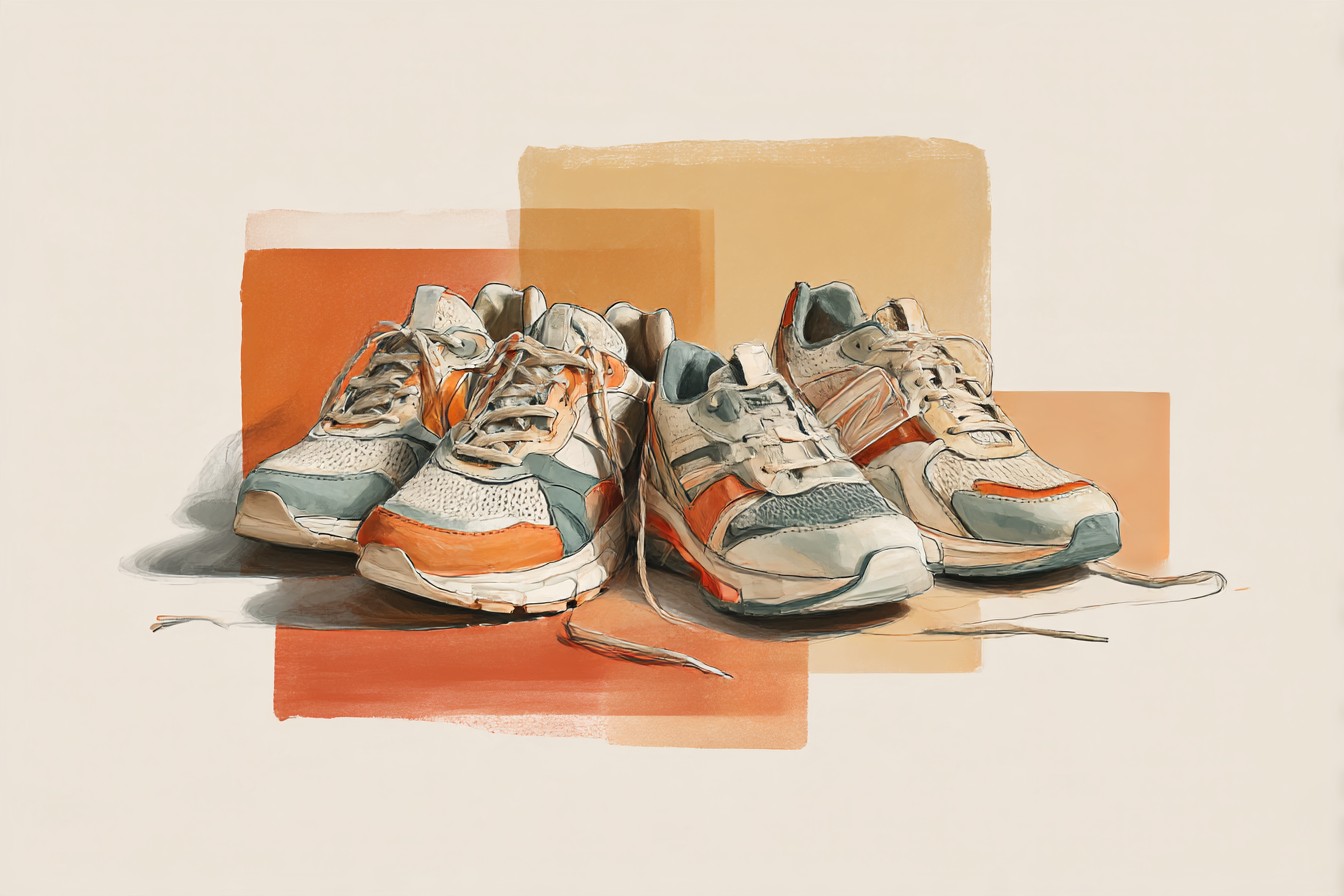
Here’s what happens when you put a men’s foot in a women’s running shoe: it fits. It cushions properly. It bends where your foot bends. It fulfills the task that any given shoe provides when it lands on a woman’s foot because your foot is a foot and rubber foam doesn’t care if society thinks it can tell your gender at dress code check.
That which differs between the shoes, and this is buried under far too many forum megathreads shouting over each other these days, is not engineering threaded through our shoe beds at a biological level. It’s fit profile. Women’s running shoes are almost universally constructed on a slightly narrower last through the heel and midfoot, sometimes of slightly lower volume across the board because those shoes are trying to match a statistical variance towards narrower foot shape that comes with, on average, being a woman. That’s it. That secret is that simple. When you slide into a women’s shoe it’s not suddenly gender reveal popping out of a birthday cake, it’s just the same damn shoe wearing a different last, just like a men’s size 9 and a men’s size 11 are the same shoe on different sized lasts. Would you start to think a size 11 was it’s own mysterious object just cuz? Good lord, when you tack “women’s” onto that shoe companies people suddenly throw physics out the window.
The problem isn’t physical, it’s categorical
See, here’s where I get legitimately mad, so prepare yourself. Companies took something that was real, feet come in different profiles of width and volume across the population, instead of selling shoes just by those dimensions how they very easily could have and should have, and put women’s and men’s labels on two piles and called it a day. Slim fit men’s shoe, standard fit women’s shoe fit your assigned at birth half of that bell curve, or too bad, you’re out of luck and go dig through whichever pile you weren’t supposed tovisit.
This is not science. This is convenience. And frankly it’s laziness too because men have narrow feet that fit women’s lasts just as easily as women have wide feet that don’t fit naturally into men’s shoe lasts. My friend Danny from above has actually notoriously narrow feet for a man. Dude’s feet are tiny. For years he’d buy mens sizes down half a shoe because his feet slid through the heel and he wasn’t sure what else to do. The solution wasn’t wearing a women’s shoe. It was a men’s size 11-Australia smh (Note: he’s since also had success going to even narrower lasts through Vivo Barefoot shoes).
The real solution was what any guy would have done… wearing a women’s 10.5 in the same exact shoe model. Same foam. Same outsole. Everything remained equal except his heel wasn’t sliding around anymore because the shoe actually fit his foot.
I want to be as blunt as possible about the conversion because that’s where people stupidly talk themselves out of trying stuff: women’s shoes are almost universally sized about a thumb length bigger than the men’s version. Men’s US 9 is about a women’s 10.5. It is not an exact transcontinental applies to all companies conversion obviously because nobody rounds the same way Asics does Brooks does Nike does etc, but it’s close enough that you can walk into the store and do the math rather than making buying shoes into a suspicious crime because you have female boobs.
I get it. Trust me, I’ve been there wondering if someone’s going to judge me too. There is an unfortunately stupid ridicule panic that flies into our heads at the very concept of holding a shoe labeled “women’s” near our own personal shopping pile. Heck I’ve done it. Straight up stood in Fleet Feet in downtown Chicago rocking a pair of women’s Hoka Bondis, excellent shoe by the way for any runner who happens to click with that narrow heel feeling, and caught myself looking around to see if anyone was giving me side eye for standing there. Someone wasn’t judging you for looking at shoes, Marcus. Let that tiny bit of concern override dozens of miles of potentially comfortable running and you’re making one of the dumbest trades in the grand scheme of things.
Fits matters. Stickers don’t.
If we remove the ridiculous baggage held behind those sticker labels what you’re really getting into is a fit conversation, and that conversation can actually be had with real answers. Get your feet properly measured. Length AND width. Don’t just buy what you think you are because that’s what you’ve always done for as long as you can remember. Wear the socks you actually run in when you try shoes on. Walk around the store. Testing a shoe shouldn’t be cursing at yourself in the mirror, it should be validating that what you feel fits, does in fact feel like fitting. If a size men’s shoe feels too loose through the heel or midfoot but the women’s shoe in the appropriately converted size cinches you in comfortably without crunching your toes then congratulations, you’ve just found the better fitting shoe for your feet. Period.
Lots will try to throw you the “but women’s shoes have different…” oh and men’s do too by the way technical here, but rest assured it is complete minutia that shouldn’t scare you off. Some shoe companies do tune different aspects of their shoes shoes’ suomi such as foam density or plate strength between men’s and womens shoes based on statistical differences in runners’ weights between the genders.
That’s fine! Acknowledge that it exists. Do not build that into some fear tactic in your mind that makes you try one shoe or the other. Try them both!
Feel it out. Your feet will seriously tell you within seconds whether that shoe was built for you or not. And the reality is it just doesn’t give a damn about the gender bubble we put on shoe boxes.
Men can wear womens running shoes. Heck I have and for 40 mile weeks at a time. The only barrier was ever that stupid label and trust me, labels don’t get to decide what you wear on your feet.

Marcus started the menswear section after getting fed up with coverage that called a two hundred and fifty pound hoodie an easy Tuesday buy. Based in London, he writes about pricing, returns policies and what brands actually deliver.